

What to do (and not to do) when you see a bear in the wild
It’s a rare experience to see a bear in the wild, so I guess you should feel lucky if you do. But to feel lucky, you first have to survive to tell the tale!
This happened to me when my travel partner and I were camping for two nights in a mountainous region in Northern India called Naranag.
Affiliate disclosure
Some links in this post are affiliate links, including Amazon Associates and other programs. That means if you buy through them, I may earn a small commission at no extra cost to you.
With us were a few other people: Jaz (our tour guide who accompanied us from Srinagar), Riyaz (our mountain guide / porter / cook), and a couple of village kids who came to help gather firewood.

On the second night, Riyaz had to leave early because his young daughter was alone at home. He left one of the boys with us to help with the fire and keep us company for the night.
The campsite was actually not very far from the village, so we had nothing to worry about (or so we thought).
Our temporary mountain guide, a 9-year-old boy named Manir, went off to gather more twigs for the fire. But barely a moment after he left, he came scampering back, screaming.
Now that’s not something you ever want to see your mountain guide do. He shouted a few words in Urdu at our tour guide, Jaz, who immediately told us to get into the kitchen tent.
At first, I thought it had something to do with the rioters — of which Kashmir had many — but soon I found out it was something else.
A huge black bear was apparently lurking near our campsite, just about 20 meters up the hill. With a speed of up to 30 mph, it could have reached us in mere seconds! I’m not sure which one would have been worse: the rioters or the bear.

For some reason, in that moment my brain failed to register how dangerous the situation really was. If it hadn’t been for Manir, I might have believed Jaz had staged the whole thing just to get us to share a tent with him (we’d been having issues with the guy since the start of our tour in Srinagar).
But Manir started sobbing in fear, and we had to take turns calming him down. We tried calling Riyaz for help, but our calls kept going to voicemail. By then, it was beginning to dawn on me that we might be in serious trouble.
When Riyaz eventually answered, there was nothing he could do. It was too risky for him to come while a bear was still roaming around.
The only option was for us to stay put inside the kitchen tent until morning. We had an axe, a kitchen knife, and a few hiking poles with us in case we needed them as weapons, though I wasn’t sure if they’d be of much help.
With only the lights from our phones, Manir — who had finally regained his composure — ladled rice and dhal onto our plates (because if we were going to die anyway, we might as well do so with full stomachs). Then, we turned off our phones and tried to get some sleep.
Sleep, of course, was hard to come by. Every little sound I heard made me think it was the bear coming to get me. It took a long time before I managed to doze off.
When I woke again, it was already bright outside, and I saw Riyaz quietly preparing our breakfast. I had never been so happy to see a man in my life.
After eating, we packed up quickly. The whole village was buzzing with talk of the bear. A sheep had been killed. The cornfield was ruined, and our little tent had been trampled on. Good thing we had stayed on in the kitchen tent that night.
Apparently, there had been another camper, but he had fled the scene in the middle of the night, running across the river with his tent and all.
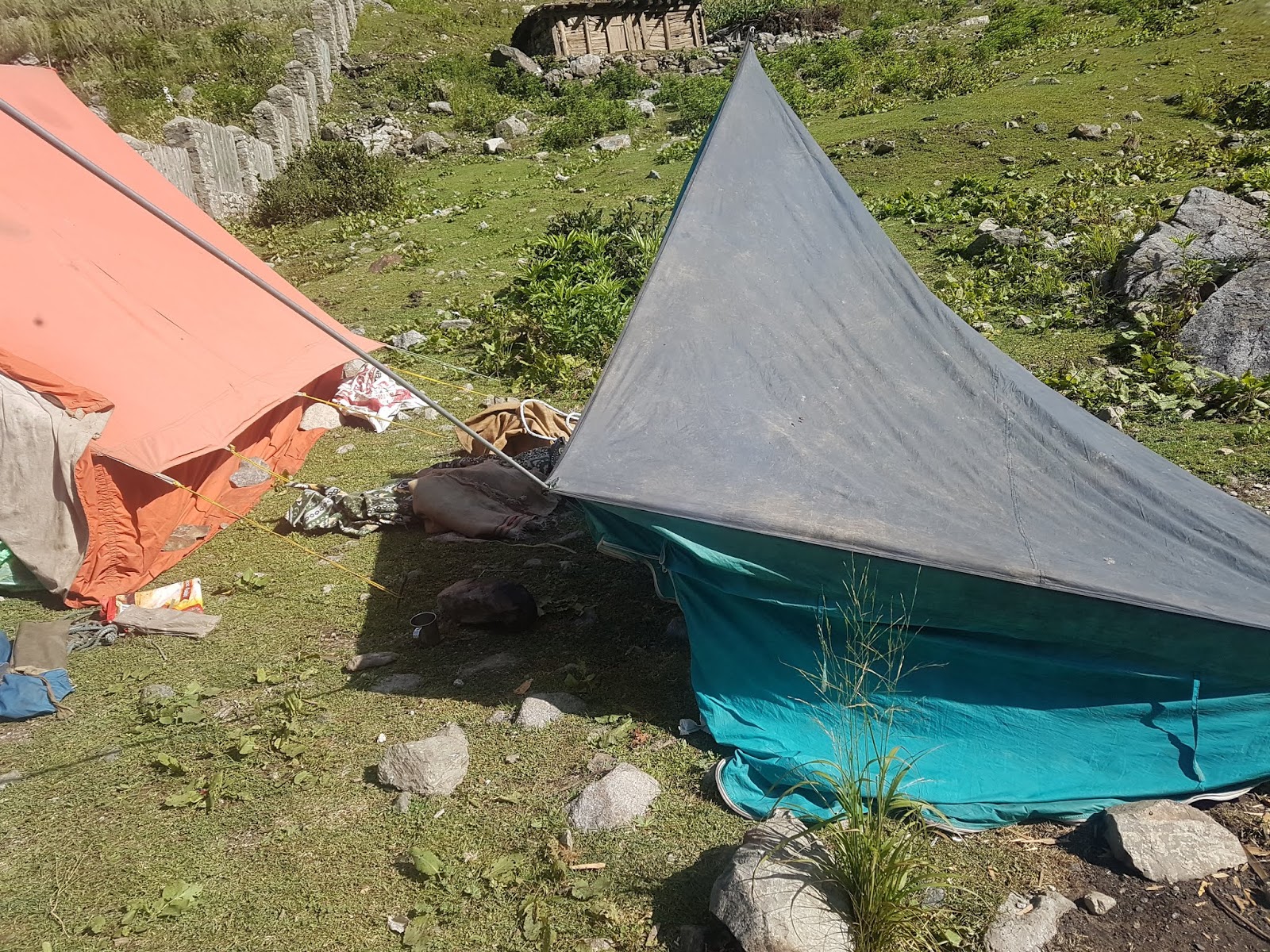
Coming from a tropical country, we had ZERO knowledge about bears. Bears simply weren’t something we thought about when planning trips to the mountains.
But if there’s any good that came out of this experience, it’s that we gained some incredibly useful knowledge. Otherwise, we might have remained ignorant and unknowingly put ourselves in danger on future trips.
So now, I’m sharing what we learned here in the hope that it might save someone’s life.
How to avoid bears
From all the resources I read, I learned that the best way to survive a bear encounter is to avoid encountering them in the first place. Here’s how to stay safe:
- Be alert to every sound and movement around you. Don’t wear earplugs or noise-canceling headphones. This advice isn’t just for the forest — it applies anywhere, even in the city.
- Make plenty of noise. Hiking quietly can actually put you at risk. Bears don’t like surprises, so don’t be afraid to belt out a tune as you go. A bear bell or bear horn is small enough to toss into your daypack and loud enough to make its presence known if needed.
- Hike in a group of at least three people. Bears are generally wary of humans and are deterred by larger groups. The bigger the group, the better. Sorry, fellow introverts!
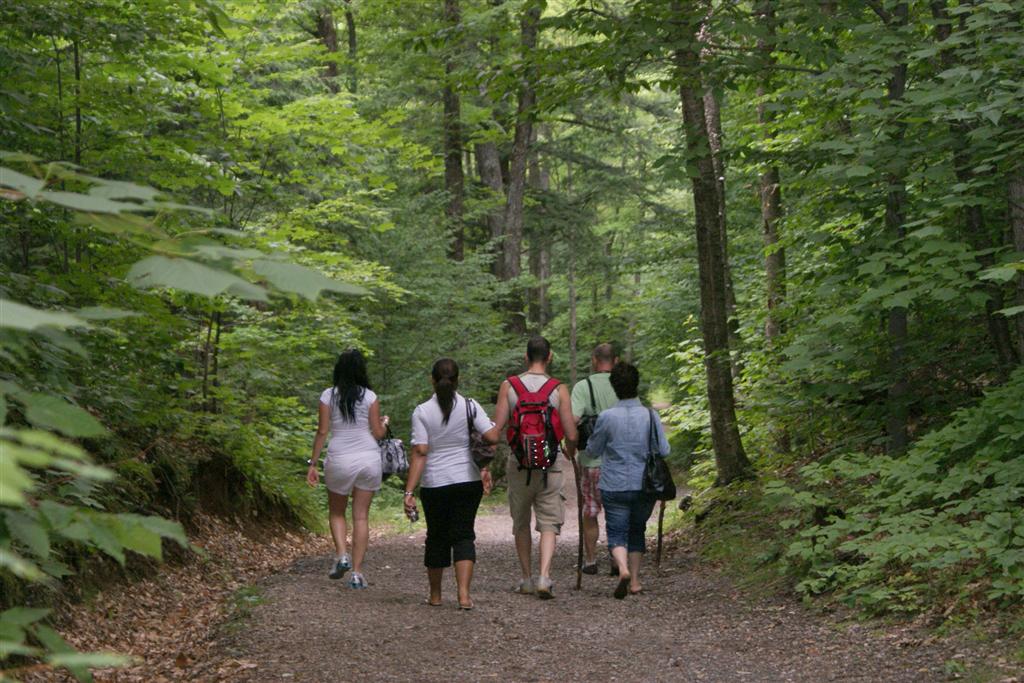
- Beware of blind corners and loud streams where a bear may not see or hear you (and vice versa).
- Avoid dense bushes or berry patches.
- If you see a bear in the distance, give it a wide berth. Consider turning back and leaving the way you came from.
- Bears have an exceptional sense of smell — 7 times more powerful than that of dogs. They can detect odors from over a mile away. Therefore, avoid bringing strong-smelling food. Use bear-proof or odor-proof containers. Do not leave food in vehicles. Learn to hang food at least 10 feet off the ground.
How to identify bears: black bear vs grizzly bear
In general, there are two common types of bears you might encounter in the wild: black bears and grizzly / brown bears.
Why is it important to know the difference? Because each type behaves differently. Understanding which bear you’re facing can help you react appropriately and increase your chance of survival.
At first glance, you might assume that all black bears are black and all grizzlies or brown bears are, well, brown and “grizzled.” Makes sense, right?
Not quite.
Black bears can come in a wide range of colors — from black and blue-black to dark brown, cinnamon, and even white. Grizzly bears aren’t limited to brown or grizzled coats either; their fur can be black, blond, or a mix of light and dark shades.
While grizzlies are generally larger than black bears, neither size nor color alone is a reliable way to identify them. For instance, how can you tell whether a small bear is a black bear or a young grizzly cub?
The most reliable method is to look for a combination of physical characteristics:

Black bear
- Face profile: Flatter “Roman-nose,” straight from forehead to nose tip.
- Shoulder: No visible hump.
- Ears and claws: Larger ears and shorter claws.
- Fur: Shorter and less dense.
Grizzly bear
- Shoulder hump: Pronounced and easily visible.
- Face profile: Concave or “dish-shaped,” curving from between the eyes to the nose tip.
- Muzzle: Broader and more prominent.
- Eyes: Set closer together and deeper in the face.
- Ears and claws: Smaller ears and much larger claws.
- Fur: Often longer and fuzzier, especially on the face.
By observing these key features, you can more confidently identify which bear you’re dealing with — an essential skill for staying safe in bear country.
What to do during a bear encounter
Now that you can tell the difference between a black bear and a grizzly, what should you do if you encounter one in the wild?
First and foremost, remain calm. I know this is easier said than done, but panicking is the worst thing you can do in a bear encounter. Sudden movements or screaming may provoke an attack.
Bears are naturally wary of humans and generally only become aggressive if they feel threatened. Avoid giving the bear any reason to perceive you as a threat.
If the bear is stationary
- Move away slowly and sideways — ideally in the direction you came from. Moving sideways helps you keep an eye on the bear while reducing the risk of tripping.
- This motion also appears non-threatening to the bear.
- Leave the area if possible. If not, wait quietly until the bear moves away.
- Always ensure the bear has a clear escape route without obstacles or people in its way.
If the bear follows you
Black bear:
- Stand your ground. Make yourself look as large as possible by standing tall and raising your arms above your head.
- If you’re in a group, stay together — groups appear larger and more intimidating.
- Speak firmly, shout, stomp your feet, and make noise. Act aggressively if necessary.
- Use any handy object, like a hiking stick, to appear threatening.
- A curious black bear can turn predatory if it perceives weakness, so a bold response is key.
Grizzly bear:
- Stay still and calm. Do not make sudden movements.
- Keep your bear spray ready in case the bear approaches.
If a bear attacks
Black bear
- Do not play dead. Fight back using any available objects.
- Aim your blows at the bear’s face, eyes, and nose.
Grizzly bear
- You cannot overpower a grizzly. Keep your backpack on and play dead.
- Lie flat on your stomach and clasp your hands behind your neck.
- Spread your legs and elbows wide to make it harder for the bear to flip you over.
- Stay still for at least 20 minutes, even after the bear leaves. Grizzlies are known to linger to ensure their threat is neutralized.
Bear in your tent
- Bears rarely stalk or attack people unprovoked. When they do that, it’s usually because they are hungry.
- In this situation, fight back, regardless of what type it is. Playing dead only makes you an easy meal.
Bear on a carcass
Bears can protect their food very aggressively. Get as far away as possible, quickly and quietly. Do not play dead and do not act threatening.
What NOT to do during a bear encounter
No matter the situation, and no matter what type of bear you are facing, there are a few things you must never do:
• Do NOT try to get closer or take a photo.
This should be obvious, but in the age of selfies, it still needs to be said. Many people underestimate how dangerous bears can be. I’ll admit that when I first heard there was a bear near our tent, my silly first thought was, “Winnie the Pooh!” Real bears are nothing like cartoon characters.
• Do NOT run.
Running makes you look like prey. Like dogs, cats, and other predators, bears are instinctively triggered to chase anything that flees. And even if you wanted to, you can’t outrun a bear — they can sprint as fast as a racehorse, uphill and downhill.
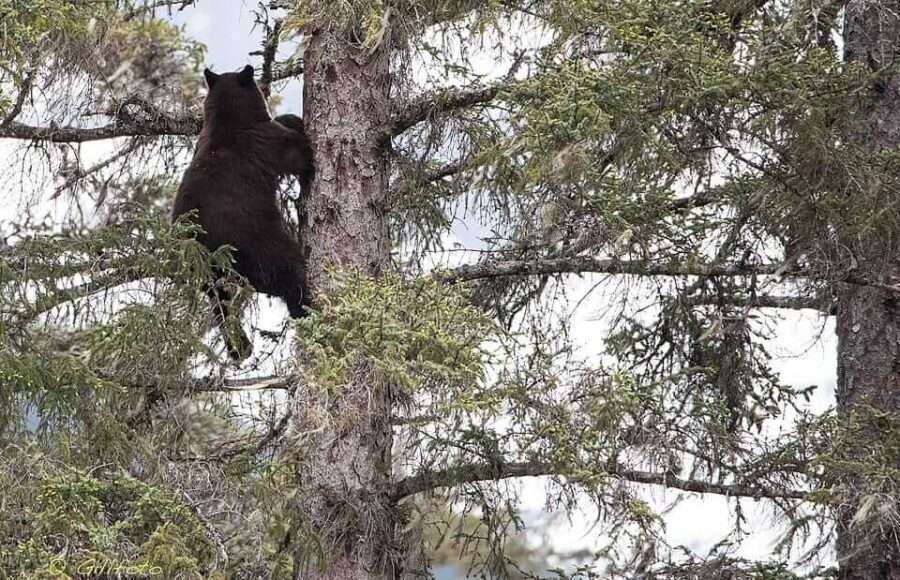
• Do NOT climb a tree.
Both black bears and grizzlies are excellent climbers. A tree will not save you.
• Do NOT scream or imitate bear sounds.
It can startle the bear or make you appear aggressive and threatening.
• Do NOT approach a mother with cubs.
This is one of the most dangerous situations. A mother bear will defend her cubs fiercely, and the risk of an attack rises immediately if she sees you as a threat.
• Do NOT drop your backpack.
If a bear does make contact, your pack can provide valuable protection for your back and neck.
• Do NOT shoot a bear.
Firearms are rarely effective against such a large animal and are more likely to injure and enrage the bear rather than stop it. Research from the U.S. Fish and Wildlife Service shows that people who use guns against bears often suffer more severe injuries than those who rely on bear spray, which is proven to be the safer and more effective deterrent.
ALWAYS carry bear spray
What is bear spray?
Bear spray is a deterrent made from concentrated hot pepper extract that temporarily irritates a bear’s eyes, nose, and throat. This causes intense burning and tearing, giving you time to get to safety.
It works in a similar way to human pepper spray, but it is not the same product. Always choose an EPA-approved bear spray designed specifically to stop aggressive bears — regular pepper spray is not strong enough.
Experts consider bear spray the most effective defense in bear country, with studies showing it is over 90% successful at preventing serious bear attacks.
How to use bear spray
- Keep it accessible. Carry bear spray on your belt or in an easy-to-reach pocket. Never store it inside your backpack.
- Prepare calmly. If you encounter a bear, slowly take out the canister and remove the safety clip.
- Wait for the right distance. Do not spray unless the bear is within about 25 feet. Using it too early will reduce its effectiveness and waste the spray.
- Aim correctly. If the bear charges, point the nozzle slightly above the bear’s head so the cloud drifts into its eyes, nose, and throat.
- Use a sustained burst. When the bear is within 20–25 feet, release a steady blast rather than short sprays.
- Never use it as a repellent. Bear spray is not meant for your body, tent, or gear.
Final thoughts
A bear encounter is not something you ever plan for. But if you spend enough time in the wilderness, it becomes a possibility you need to take seriously.
What can make a big difference is preparation. Go informed, respect distance, and carry the right safety gear. Knowing what to do ahead of time helps prevent panic from taking over.
It’s impossible to eliminate risk entirely. But you can understand it, prepare for it, and respond calmly if something unexpected happens.



Pingback: Spending One Night in A Soviet Prison in Latvia - Ummi Goes Where?
Pingback: Basic Outdoor Survival Skills You Should Know Before You Go Camping – Ummi Goes Where?
I’m scared of bear. They are so huge and scary.
Yes, Warda, they are.
Wow!!!!!!!!!!! What an experience! Bears are beautiful creatures. But of course, they can be harmful too. Thank you for sharing your experience and tips with me. I’m looking forward to read more of your post after this.
Thank you for your continuous support, Fadima! Bears are indeed beautiful creatures, but as with other wild animals, we need to stay out of their way if possible. But if an encounter is unavoidable, then we need to know how to handle the situation. 🙂
Thank god that both of u are safe. Belum experience encounter a bear, masa hiking trip which of course camping, cuma encounter wakanda & tapir. but luckily nothing happen
Seriously jumpa black panther and tapir? Menarik tu, tapi menakutkan juga. Nasib baik takde apa2.
OMG! If I were to be in such a dangerous I would be very shocked as well and will be clueless.
Can’t blame you, Tekkaus. If it were to happen to me again (heavens forbid), I doubt I’ll remember what to do! The best we can do is equip ourselves with the necessary knowledge and equipment, and hope that if it happens, our brain won’t freeze
Winnie the Pooh 😂 I thought so too mula-mula. But, baca in details like whattt..two different defences for each bear? Huhu.. nak nangis 😭
Ya, Edahyu. Tu la dia masalahnya. Kalau terserempak dengan beruang kat depan mata, rasanya blank terus. Tak ingat dah nak tengok bentuk kepala dia ke apa.
Fuh i baca memamg sungguh mendebarkan ye. Kalau i mesti jatung dh laju dh menangis.. Huhu.. Tengok kat zoo pun besar bear ni.. In real tak tau la nak cakap. Nasib baik selamat semuanya ya..
Ya, Nadia. Nasib baik selamat semuanya. Tak lena tidur jugak malam tu, walaupun saya tak sempat tengok sendiri beruang tu depan mata. Nasib baik kami berempat. Kalau saya seorang diri, tak tau la.
Thank you for sharing the bear knowledge. I didn’t counter any wild animals before, but I am good when I encounter teddy bears, I will hug the teddy bear first.
You’re welcome, Jenny. Just don’t go hugging a real bear like you would your teddy bear!
Fuhh seram pulak baca experience awak. Mujur semua selamat. Tapi selalu juga dengar kalau jumpa bear buat2 mati tapi berani dengan tak je nak buat kan. Hehe
Ya, Ana. Tapi nak kena tau juga apa jenis beruang yang kita jumpa tu. Kang kalau buat-buat mati, tak pasal2 je jadi makanan dia.
Good info about the bear. I love hiking esp in group. More safe and happening
When I hike, I like peace and quiet. There’s already too much chaos in my daily life. But you’re right — it’s safer to go in a group.
wah bestnya this article. didnt know there are different types of bears in the wild. now i know how to protect myself in case this encounter happens!
Great! As they say, expect the best but always be prepared for the worst. 😉
I love reading this article and good knowledge for me a least. but don’t know will this knowledge turn blank when I encounter this situation.. 😛
Honestly, I think I would also go blank if I encounter this situation again 😆
Seronoknya dapat travel around the world. Bila baca how to avoid bear tu teringat episod spongebob kena avoid bear hhahahah
Haha, saya belum pernah tengok lagi episod tu 😄
Fuhh menarik pulak baca experience awak. Suka baca article awak dapat tambah pengetahuan yang baik yang dapat Nina pelajari. Saya pun baru tahu beruang ni ada pelbagai jenis.
Ya, Nina. Beruang ada pelbagai jenis, tapi di kebanyakan hutan pokok pain biasanya ada dua je, iaitu black bear dan grizzly bear. Dan kita kena tau bezakan supaya kita tau macam mana nak bertindak jika terserempak. Sebab lain beruang, lain caranya. 🙂
Nampak cute bear tp dia menyerang yaa.. tapi kalau dia rasa kita ancam dia baru dia serang kann… kalau Sis jumpa depan pun, memang lari juga kot hahahaha
Ya sis, biasanya kalau dia rasa terancam, baru dia serang kita. Tapi kalau ikut artikel2 yang saya baca, ada juga yang datang serang sebab lapar.
it would have been a terrifying experience for me but I’m glad now I know some tips and what to do.
Glad to share the tips with you, Lee. Do bookmark this page so that you can refer to it again when you do visit a bear region in the future. 🙂
OMG… i feel funny with DO NOT PLAY DEAD… gee… and fight back? hahaha I think I will lari lintang pukang d…
Hahaha, I suppose that’s what’s everyone’s first instinct would tell them to do. But according to experts, when it comes to a certain type of bears, fighting back would be the best course of action. I hope I’ll never be put in the situation where I’ll have to prove or disprove this theory though!