

Experiencing Loi Krathong in Thailand: A Complete Guide to the Festival of Lights
After visiting Thailand at least once a year for almost a decade, I’ve learned one very important thing: the Thais really love festivals.
If there’s a reason to celebrate, they’ll find it — the new year, the full moon, the changing seasons, and probably a few things in between. No wonder Thailand is called the Land of Smiles — there’s plenty to be happy about.
Out of all of them, Loy Krathong is one of the biggest and most well-known. I experienced it for the first time at Asiatique in Bangkok, but the festival isn’t defined by one place.
Whether it’s celebrated in a major city, a small town, or beside a quiet canal, the heart of the festival is the same, and it’s felt all across Thailand.
Affiliate disclosure
Some links in this post are affiliate links, including Amazon Associates and other programs. That means if you buy through them, I may earn a small commission at no extra cost to you.
What is Loy Krathong?
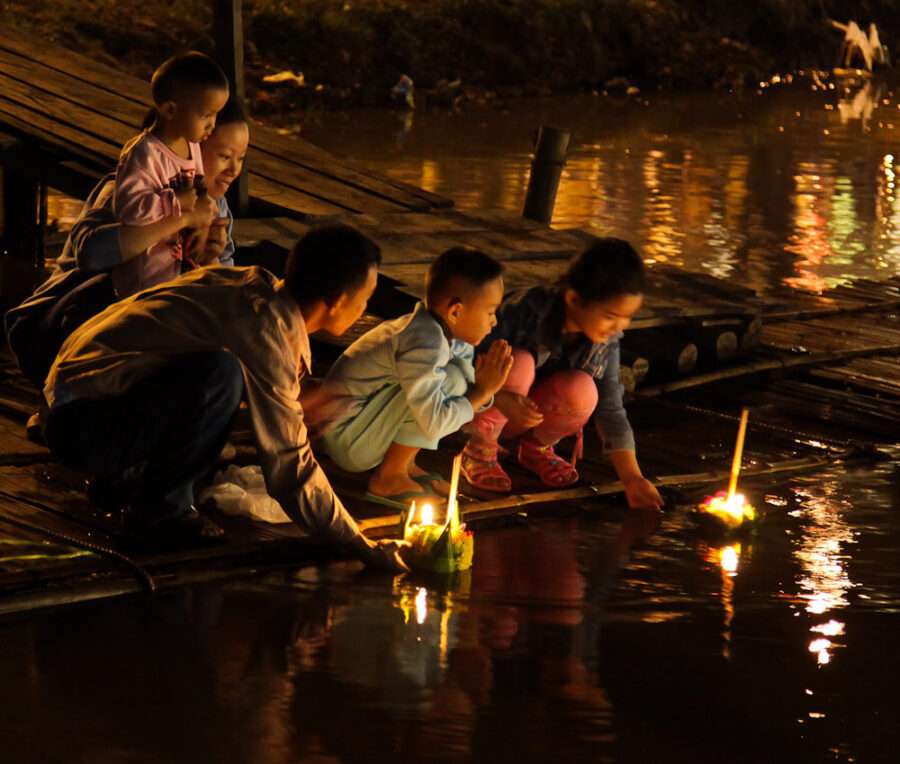
The name Loy Krathong tells you a lot about the festival. Loy means “to float,” while krathong refers to the small lotus-shaped baskets that people release onto rivers, lakes, or canals.
These baskets, usually made from banana leaves and decorated with flowers, candles, and incense, are central to the celebration.
The festival is celebrated for several meaningful reasons:
End of the rainy season: Loy Krathong marks the transition from heavy rains to clearer skies — perfect timing for reflection and celebration.
Thanking the water goddess: Participants honor Mae Khongkha for providing clean water throughout the year.
Seeking forgiveness: The festival is also a way to apologize for overusing or polluting water.
Cleansing the soul: Floating a krathong symbolizes letting go of misfortunes, past mistakes, and negative thoughts while making wishes for the year ahead.
Loy Krathong is often called the Thai Festival of Lights, but it’s not the same as Yi Peng, the sky lantern festival celebrated in northern Thailand, especially Chiang Mai.
While Yi Peng lights up the sky, Loy Krathong focuses on floating the baskets on water, giving the festival a unique and reflective charm.
Yi Peng (Sky Lantern Festival)

Loy Krathong (Floating Basket Festival)
When is Loy Krathong celebrated?
Loy Krathong is celebrated on the evening of the full moon of the 12th month in the traditional Thai lunar calendar.
Because it follows the lunar calendar, the date of this festival changes every year, but it usually falls in November, right at the end of the rainy season.
Loy Krathong dates for 2026 & 2027:
- 2026: Nov 25th
- 2027: Nov 14th
Where to experience Loy Krathong in Thailand
Loy Krathong takes place nationwide, which makes it one of the easiest Thai festivals to experience no matter where you’re traveling. From bustling cities to small rural towns, communities will gather near water to celebrate together.
Typically, people will flock to the river to celebrate, but those who don’t live near one will make do with any body of water, including canals, lakes, ponds, and coastal areas. Some hotels even hold mini celebrations at their swimming pools.

However, the liveliest places to celebrate Loy Krathong are Bangkok, Chiang Mai, Phuket, and Sukhothai (where the festival is said to have originated in).
Regional variations across Thailand
Northern Thailand
In northern Thailand, especially around Chiang Mai, Loy Krathong often overlaps with Yi Peng, the sky lantern festival. While Loy Krathong focuses on water, Yi Peng emphasizes the sky, with lanterns symbolizing the release of misfortune.
Experiencing both together offers a deeper understanding of regional culture and Buddhist symbolism.
Central, southern, and rural areas
In central Thailand, celebrations tend to be larger and more organized, while in rural areas, Loy Krathong feels more community-centered and personal.
In the south, the festival is often quieter, with families gathering near the sea or local waterways rather than attending large-scale events.
Celebrating Loy Krathong in Bangkok
If you’re in Bangkok, you’re in luck — you can witness (and join) the festival all along the Chao Phraya River.
If you don’t mind big crowds (honestly, why go to a festival if you hate them?), check out Asiatique The Riverfront. It’s an open-air shopping mall and entertainment complex by the river, and that’s where all the action happens.

To get there, take the BTS to Saphan Taksin, and head to the pier where hotel shuttle boats depart. Look for the one that goes to Asiatique. It’s a free shuttle, which is always a bonus. If you can, try to arrive early, ideally before 6 p.m., to avoid long queues.
Being a Thailophile, I had planned my trip around Loy Krathong, naturally choosing Asiatique for the experience. But I got to Bangkok late, having spent the day in Lopburi, hunting for sunflower fields.
By the time I reached Bangkok, it was 6.30 p.m. and the metro stations were already packed with festival goers, everyone sticky with sweat and excitement.
How to buy the krathong
Krathongs are traditionally made from banana leaves and decorated with flowers, three joss sticks, and a candle.
Each element has its own meaning: the candle represents knowledge and wisdom, the joss sticks symbolize purity and sympathy, and the flowers honor monks.
Right after leaving Saphan Taksin station, I noticed tables being set up along the walkway toward the pier, many already displaying krathongs.
They came in all shapes and sizes, with prices to match. A typical krathong costs around 50 baht, though I managed to find a smaller one for 30 baht.

At the stall where I bought mine, nothing was ready yet. Banana leaves and flowers were scattered across the table, and the sellers were making krathongs on the spot at an impressive speed.
As soon as one was finished, I grabbed it before anyone else could—at the rate they were going, the table would never display a finished product for long.
These days, krathongs no longer stick to the traditional simple design. Some are actually very elaborate. I wonder if the bigger and more ornate your krathong is, the happier the water goddess will be, and the more likely she is to grant your wish.

Some people even add coins to theirs to bring in more luck and fortune. I hope the goddess isn’t as materialistic as they make her out to be, because if we play by that rule, I might never get any wish granted.
My krathong was small and simple. While others’ had multiple tiers and an assortment of flowers, mine only had three purple orchids and three yellow flowers (marigolds, I think?). Minimalist, yes, but I liked it better that way.
Whatever design you choose, stick to natural materials like banana leaves, banana tree bark, real flowers, or even bread. Avoid Styrofoam, plastic, or glossy paper, as the krathongs will end up in the river.
Releasing the krathong into the river
After buying the krathong, I joined the queue for the shuttle boat to Asiatique. The crowd was massive.

Judging by the number of people, I thought I might not get there before 10 (the last shuttle back was at 11). Surprisingly, I made it, though the ride was painfully slow, waiting for other boats to clear the way.
But don’t worry — it will be all worth it once you get there. That is, if a lively night is what you’re after.
Because a lively night is what you’ll get. Asiatique houses 1,500 shops, 40 restaurants, a 60-meter Ferris wheel, and a huge event space. That night, the space was filled with food stalls, tables, and a stage for cultural performances.
There were lots of singing and dancing:
And more food than you can imagine. It really got me in the festival mood. Find out what exotic food I tried there.
Along the river, people lowered krathongs into the water using long poles with baskets attached. I didn’t have a lighter for the candle and joss sticks, so I had to borrow from strangers. Locals say if your candle stays lit as your krathong floats down the river, your wish will come true. Mine went out before it even entered the basket, and I simply didn’t want to go through the trouble of borrowing a lighter again.
Just as the design of the krathongs has evolved over the years, so has the festival itself.
For many young Thais, it’s less about religion and more about celebrating with friends and family. Couples often use the occasion to make a wish for happiness in their relationship.
Even if you’re skeptical about water goddesses, releasing a krathong can still be a meaningful symbolic gesture: letting go of the past and welcoming the new.
Some people even include strands of hair, nail clippings, or old clothes in their krathongs to symbolize mistakes, bad luck, or habits they want to leave behind.
I think it’s a beautiful way to reflect on the past, focus on the future, and appreciate what you have.

Where to stay near Asiatique, Bangkok
If you’re planning to experience Loy Krathong near Asiatique in Bangkok, choosing the right place to stay can make your visit even more enjoyable.
Staying nearby lets you easily join the evening festivities, watch the floating krathongs along the river, and soak in the magical atmosphere without worrying about transportation.
These hotels are all within 1 km of Asiatique:
Budget
- Meemaw’s House Hostel — Private rooms with shared bathrooms and kitchen.
- PAMAhouse Boutique Hostel — Dormitories and private rooms, with a shared kitchen and lounge.
- 89 Bed & Studio Hostel — Dormitories and private rooms, some with private bathrooms.
Mid-range
- Ramada Plaza by Wyndham Bangkok Menam Riverside — A 5-star hotel with a swimming pool, fitness center, business center, and restaurant.
- Hotel Once Bangkok — An elegant hotel with a pool and restaurant. Rooms come with a coffee machine and bathtub, some with a jacuzzi.
- Away Bangkok Riverside Kene — Features a swimming pool, fitness center, restaurant, bar, and coffee shop.
Luxury
- The Salil Hotel Riverside Bangkok — A luxury hotel with a saltwater swimming pool, spa, sun terrace, fitness center, restaurant, and garden.
- Chatrium Hotel Riverside Bangkok — A riverside hotel with an infinity pool, spa, fitness center, and restaurants. Rooms come with floor-to-ceiling windows and balconies.
- Ten Six Hundred, Chao Phraya — A 5-star hotel managed by The Ascott Limited. Features a rooftop pool, fitness center, restaurant, lounge, and bar.
What to bring to a Loy Krathong celebration
- Krathong: Either handmade or purchased locally. Biodegradable is best.
- Lighter or matches: Needed to light the candle on your krathong.
- Small change: For buying krathongs, snacks, or souvenirs at local stalls.
- Camera or smartphone: To capture memories, but focus on the moment too.
- Modest clothing if you plan to visit temples nearby.
- Handheld battery-operated fan. It can get hot and stuffy, especially in big crowds.
Tips for experiencing Loy Krathong respectfully
Travelers can enhance their experience by being mindful of cultural norms and environmental impact:
- Dress modestly if you’re attending events near temples.
- Choose eco-friendly krathongs and avoid releasing anything into the water that could cause pollution.
- Observe how locals participate and follow their lead.
- Arriving early allows time to watch preparations and avoid peak crowds.
- Staying present and mindful rather than focusing solely on photos, helps capture the true spirit of the festival.
FAQs about Loy Krathong
Is Loy Krathong the same everywhere in Thailand?
The meaning remains the same nationwide, but the atmosphere and traditions vary by region, depending on local customs and natural surroundings.
Do tourists need to participate to enjoy the festival?
Participation is optional. Watching, learning, and observing respectfully is just as meaningful as floating a krathong.
Is Loy Krathong environmentally friendly?
Traditional krathongs are biodegradable, but modern practices vary. Choosing natural materials helps reduce environmental impact.
How long does Loy Krathong last?
The main celebration happens over one evening, though related events and festivities may take place for several days in some areas.
Can Loy Krathong be experienced outside major cities?
Yes, and many travelers find smaller towns offer a more intimate and culturally immersive experience.
If you’re looking for more meaningful cultural experiences around the world, here’s my full travel bucket list.


Pingback: How to Visit Lopburi Sunflower Fields - Ummi Goes Where?
Suka sangat baca pengalaman ummi. Terasa macam Sisyat sendiri merasai perjalanan tu 😊
Thanks for your support, Sisyat! :-* I will try to produce more quality content.
I would like to experience and celebrate Loy Krathong in Thailand when we are able to travel abroad.
Hope you’ll get to experience it someday 🙂
I suka tengok you.. Travrl.. Buat macam2.. Cuba macam2. Loy krathong ni i perng buat nampak dekat shopping mall, just decorations. You tengok festival dia betul2.. Fuh meriah
Hehe I memang suka cuba benda baru. Thank you for your support, Nadia. Maybe one day you’ll get to join loy krathong festival in Thailand too! 🙂
this seems like such an interesting festival. cant wait to explore after the pandemic is over!
Yup, everything’s put on hold because of the pandemic 🙁
Reading this made me wanna book my flight ticket to Bangkok now but unfortunately we can’t travel at the moment.. The last event i join was Songkran last year! Asiatique really nice right, especially at night! and they have really exotic food selling on their food street, was so amazed by that 😛 but i didn’t try it… The Rolling Baby Crocodile 😛
Oh I did try that ‘really exotic food’, hehe. You could read about it in my other article. Anyway, I haven’t had the chance to celebrate Songkran yet. Was in Krabi for Songkran last year, but it wasn’t that big there.
Meriahnyaa, kalau dapat saksikan sendiri pengalaman ni mesti seronokkan..Sis dah sampai Asiatique tu, cuma takde apa-apa festival laa masa tu, pun dah meriah…
Saya pun baru first time pegi Asiatique. Walaupun dah berkali-kali pergi Bangkok sebelum tu, tapi tak pernah tau.
Everytime, i read your blog.. I was like wow wow… So many beautiful places you visited.
Thank you so much for your kind words, Ayu! Indeed, the world is a beautiful place 🙂
Pingback: How to DIY A Trip to Maeklong Railway Market | Ummi Goes Where?
Pingback: Eating Crocodile Meat in Thailand – Yum or Yuck? | Ummi Goes Where?
Pingback: How to Choose Your First Solo Destination – Ummi Goes Where?