

This post was originally published in 2019 and has been periodically updated to reflect the most current travel information.
Mui Ne Sand Dunes, Vietnam Travel Guide
When you think of Southeast Asia, deserts probably aren’t the first thing that come to mind.
Tropical beaches, rainforests, and rice terraces, maybe. But rolling sand dunes that look like they belong in the Sahara? Probably not.
Yet tucked away along Vietnam’s southeastern coast lies one of the region’s most unexpected landscapes: the Mui Ne Sand Dunes.
While it’s not technically a true desert, the vast White Sand Dunes are about as close as you’ll get in Southeast Asia.
As someone who grew up in the region, I had no idea this place even existed until a friend mentioned it.
Although she had traveled far less than I had, she had an uncanny talent for sniffing out photogenic destinations, so for once, I happily let someone else do the planning.
Affiliate disclosure
This post contains affiliate links including Amazon Associates, which means I may earn a commission from qualifying purchases at no extra cost to you. For more details, please read my Privacy Policy.
Mui Ne Sand Dunes, Vietnam

So how did these sand dunes end up on Vietnam’s coastline?
It does sound a little strange at first.
The Mui Ne Sand Dunes aren’t actually a true desert. Instead, they’re a vast coastal dune system formed over thousands of years as strong sea breezes carried beach sand inland, gradually piling it into rolling hills.
Over time, some areas became stabilized by vegetation, while others continued shifting with the wind, creating the ever-changing landscape you see today.
These dunes aren’t just beautiful. They also play an important role in protecting the coastline by acting as a natural barrier against storms and coastal erosion.
They help reduce flooding during extreme weather and provide habitat for a variety of plants and wildlife.
Although there are several sand dunes scattered around Mui Ne, the two most famous are the White Sand Dunes (Bàu Trắng) and the Red Sand Dunes (Đồi Cát Đỏ).
Both are popular attractions, but as you’ll soon discover, they offer very different experiences.
Best time to visit the Mui Ne sand dunes

Mui Ne has a tropical climate and is one of the driest places in Vietnam, receiving far less rainfall than most of the country. This unique climate is one of the reasons the famous sand dunes were able to form in the first place.
The best time to visit Mui Ne is during the dry season from November to April, when you’ll have the highest chance of sunny skies and calm weather. Daytime temperatures typically range from 80°F to 90°F (27°C to 32°C), so be prepared for the heat.
The rainy season generally runs from May to October. Even then, Mui Ne doesn’t receive as much rain as many other destinations in Vietnam.
Showers are often brief and tend to occur in the late afternoon or evening, although heavier rainfall is possible during September and October.
We visited in November, and while the weather was perfect for sightseeing, the sand dunes were still scorching hot by the afternoon.
If you’re planning to spend a lot of time walking around the White Sand Dunes, I’d recommend joining a sunrise tour instead.
Not only is the sand much cooler underfoot, but you’ll also get softer light for photos and fewer ATV tracks disrupting the landscape.
How to get to Mui Ne
Mui Ne doesn’t have its own airport, so most travelers arrive overland. The easiest and most popular route is from Ho Chi Minh City (Saigon), which is around 220 km (137 miles) away.
Thanks to the newer expressway, getting there is now much quicker than it used to be.
If you’re already visiting other destinations in southern Vietnam, you can also reach Mui Ne from Da Lat or Nha Trang by bus or private transfer, but Ho Chi Minh City remains the main gateway for most visitors.
By bus or limousine van
We went by bus because that was the cheapest option.
Today, there are plenty of companies operating daily services between Ho Chi Minh City and Mui Ne, ranging from regular buses to more comfortable limousine vans.
Most hotels and travel agencies can help you book tickets, but these days it’s just as easy to book online through platforms like 12Go.
Expect to pay around US$6 to US$15, depending on the type of bus, with the journey taking approximately 3.5 to 5 hours.
There are generally three types of buses:
- Regular seated coach: The most straightforward option if you prefer sitting upright like on a normal bus. It’s usually one of the cheapest choices and a good option for daytime travel.
- Sleeper bus: Features reclining bunk-style beds where you can stretch out. This is probably the most iconic way to travel around Vietnam and is ideal for longer journeys or overnight trips.
- Limousine van: A small luxury van with fewer, wider reclining seats. It costs a little more but is generally the most comfortable option.
We traveled on a sleeper bus, and at 5’5″ (165 cm), I had just enough room to stretch out comfortably. I imagine taller travelers may find it a little cramped.
Shoes weren’t allowed onboard, so everyone was given a plastic bag to store them before boarding.


By train
If you prefer traveling by rail, you can take a train from Ho Chi Minh City to Phan Thiet Railway Station, then continue to Mui Ne by taxi or Grab. The train journey takes around 4 hours, followed by another 20 to 30 minutes by road.
It’s a comfortable and scenic option, but is generally less convenient than taking a direct bus since you’ll need to arrange transportation for the final stretch. Click here to check the latest train schedules and fares.
By private transfer
If you’re traveling with family or friends, a private transfer is the most convenient option.
Although it’s the most expensive choice, splitting the cost between several people can make it reasonable, especially if you’re traveling with luggage or want the flexibility to leave whenever you like.
Where to stay in Mui Ne
There are three main areas to stay in Mui Ne, depending on the kind of trip you’re planning.
Ham Tien & Mui Ne Beach (best for first-time visitors)
Most travelers stay along Ham Tien-Mui Ne Beach, where you’ll find the widest choice of resorts, hotels, restaurants, cafés, and kitesurfing schools.
It’s also the most convenient base for visiting the White and Red Sand Dunes, Fairy Stream, and Mui Ne Fishing Village.
We stayed at Cocosand Hotel, one of the cheapest guesthouses we could find at the time. It wasn’t fancy, but it was clean, comfortable, and had a lovely shaded courtyard where we could relax after a day of sightseeing.


Phan Thiet City (best for local experiences)
About 20 to 30 minutes from Mui Ne Beach, Phan Thiet offers cheaper accommodations and food, along with a more local atmosphere.
It’s a good choice if you’re arriving by train or don’t mind taking a Grab or taxi to the main attractions.
Tien Thanh Beach & Ke Ga (best for a quiet getaway)
If you’re after a peaceful beach vacation, Tien Thanh Beach and nearby Ke Ga offer fewer crowds and lower hotel prices.
Just keep in mind that they’re farther from Mui Ne’s main attractions, so you’ll need your own transportation or longer taxi rides.
How to visit the Mui Ne sand dunes
The White Sand Dunes (Bau Trang) are located about 25 miles (40 km) northeast of Ham Tien, while the Red Sand Dunes are much closer, just 2 miles (3 km) from Mui Ne Fishing Village.
Depending on your budget and travel style, there are several ways to visit them.
Rent a motorbike
If you’re comfortable riding a motorbike, this is easily the most flexible way to explore the Mui Ne Sand Dunes.
Rentals are inexpensive, usually costing around $6 to $10 per day, and you’ll have the freedom to visit whenever you like without rushing back to a tour bus.
The roads are generally in good condition, and the coastal drive itself is part of the experience.
Just remember to bring plenty of water, wear sunscreen, and drive carefully. Unfortunately, accidents involving tourists on rented motorbikes aren’t uncommon in Vietnam.
Join a tour
The easiest way to visit the Mui Ne Sand Dunes is by joining a tour.
Most hotels, guesthouses, and travel agencies offer sunrise and sunset tours that typically include the White Sand Dunes, Red Sand Dunes, Fairy Stream, and Mui Ne Fishing Village.
You can generally choose between a shared tour or a private one. Being the budget travelers that we were, we went with a shared tour.
Depending on the tour operator, you’ll travel in either a jeep or a minivan with other travelers, stopping at each attraction for a set amount of time before moving on to the next.
It’s an easy, hassle-free way to see the highlights without worrying about transportation or planning your route.
What to expect on a Mui Ne sand dunes tour
The two most popular Mui Ne Sand Dunes tours are a sunrise tour and a sunset tour. The sunrise tour usually begins around 4:30 to 5:00 a.m., while the sunset tour departs around 1:30 p.m.
Both typically include stops at the White Sand Dunes, Red Sand Dunes, Fairy Stream, and Mui Ne Fishing Village.
We opted for the sunset tour because, well… sleeping in sounded like the better life choice.
Our driver picked us up shortly after lunch, and we headed straight to the furthest stop first: the White Sand Dunes.
The White Sand Dunes (Bau Trang)
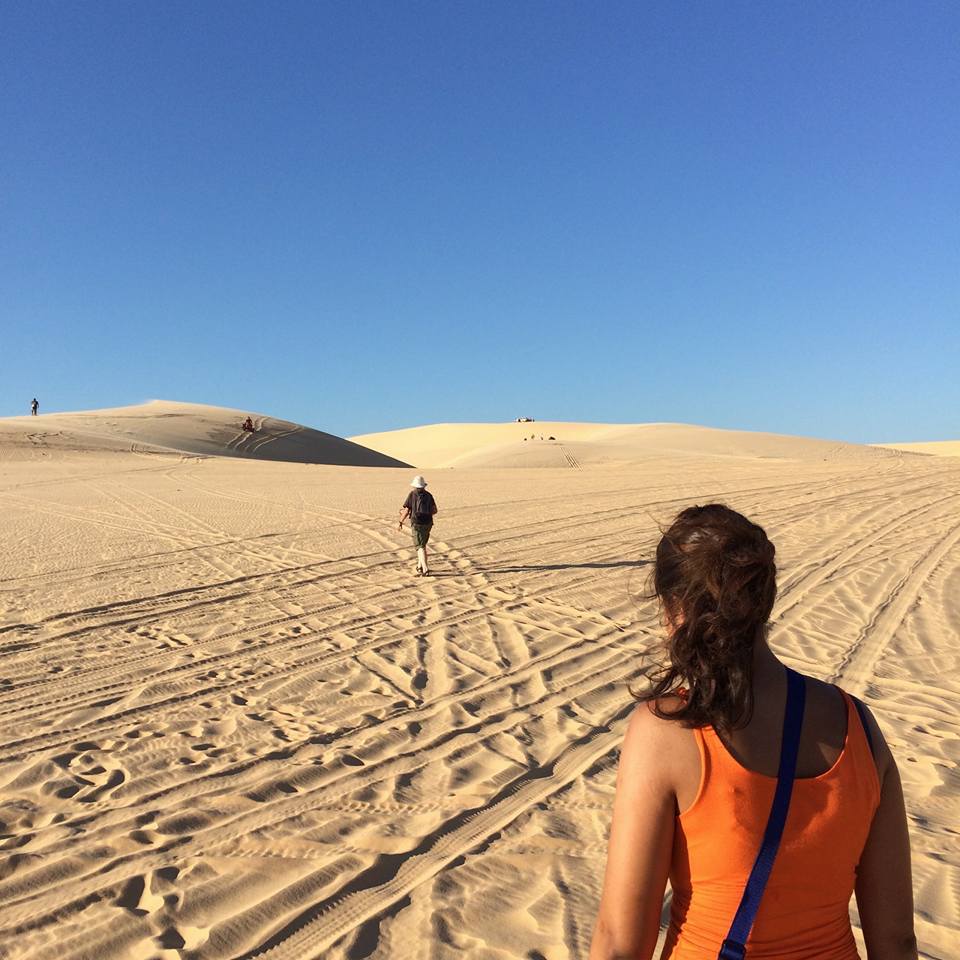
The White Sand Dunes were exactly what we imagined a desert should look like: rolling hills of fine white sand stretching as far as the eye could see.
Well… almost.
The landscape was crisscrossed with ATV tracks, so it wasn’t quite the untouched Sahara fantasy you might imagine. But standing there, surrounded by endless sand under a cloudless blue sky, it still looked like a legit desert to me.

The White Sand Dunes are also known locally as Bau Trang, or White Lake, because they’re located beside a series of freshwater lakes that bloom with lotus flowers during the warmer months.
From the higher dunes, you can catch glimpses of the lake shimmering in the distance.
Private jeep tours usually drive right down to the lakeshore, but since we were on a group tour and exploring on foot, we didn’t want to wander too far and risk holding everyone up. We managed to spot it from afar, though.
Local kids were wandering around selling drinks, snacks, and thin plastic sleds for sliding down the dunes.
Being the cheapskates that we were, we skipped the rental and instead borrowed one that had been abandoned in the sand by a previous visitor. In our defense, reduce, reuse, recycle.
If you do rent a sled, make sure you agree on the price beforehand. There have been plenty of reports of tourists being charged more than expected afterward.
It was just as well that we didn’t buy any, because the thing didn’t work.
We perched ourselves on the steepest dune we could find, leaned forward, and waited for gravity to do its thing.
Nothing.
We shuffled forward. Still nothing.
Eventually, we ditched the sled altogether and tried sliding down on our butts instead.
The only thing that moved quickly was the heat transferring from the scorching sand into our skin.


Later, a quick Google search revealed that we were supposed to use the sled while standing, almost like sandboarding.
Unfortunately, that discovery happened after we’d already flown home.
Even with our failed sandboarding debut, we had a blast running, jumping, and sinking into the soft dunes like a couple of cats in a giant litter box. At one point, the strong coastal winds whipped up a mini sandstorm.

If walking through the dunes sounds like too much work, you can also rent an ATV or ride in a dune buggy.
Most visitors either drive an ATV themselves or hire a local driver to tear across the sand. The ride looks like a lot of fun, although those tire tracks are also the reason the dunes aren’t quite as pristine as they should be.
Mui Ne is also one of the few places in Vietnam where you can take a hot air balloon ride over the sand dunes, although these flights depend heavily on weather conditions and aren’t available every day.
As we were making our way back to our van, one of the buggy drivers took pity on us and offered us a free ride. Naturally, we accepted.

Mui Ne Fishing Village
On the drive back toward town, our guide made a brief stop at a hilltop viewpoint overlooking Mui Ne Fishing Village.
Hundreds of colorful fishing boats bobbed offshore while the village buzzed quietly below. It wasn’t a long stop, but it offered one of the best panoramic views of the coastline and was a nice change of scenery.

Fairy Stream
Our next stop was the Fairy Stream, a shallow stream that winds between colorful limestone and sandstone formations.
Before we started walking, we were handed plastic bags to carry our shoes while we waded barefoot through the ankle-deep water.
If you prefer to keep your feet dry, there’s also a narrow path running alongside the stream, although the barefoot walk is part of the experience.
I also made a new friend:

Compared to the dramatic White Sand Dunes, the Fairy Stream felt a little underwhelming. Still, it was a pleasant stroll, with some interesting rock formations to look at.
It was also a welcome chance to cool our feet after baking under the afternoon sun.

The Red Sand Dunes
Our final stop was the Red Sand Dunes, just in time for sunset.
These dunes are much smaller than the White Sand Dunes and sit much closer to Mui Ne’s main tourist area, making them far easier to access. Unfortunately, that convenience also meant they were busier.
Having just come from the vast White Sand Dunes, we couldn’t help feeling a little underwhelmed.
Visitors were scattered across the dunes waiting for sunset, while vendors wandered around selling drinks, snacks, and even steaming bowls of pho.
It had a much livelier atmosphere for sure, but it also felt less wild and less like a desert.

The sunset itself was beautiful, but if I’m being completely honest, I found myself wishing we’d stayed at the White Sand Dunes instead.
The scenery there simply felt more spectacular, and watching the sun sink over those endless rolling dunes would have been the perfect ending to the day.
Tips for visiting the Mui Ne sand dunes
- Take the sunrise tour if possible. It offers the best views, softer light for photos, and cooler temperatures, so you can walk barefoot and sit on the sand more comfortably. Better yet, the dunes are still relatively untouched by ATV tire tracks, much like fresh snow before anyone has walked across it.
- If you’re doing the sunrise tour, bring some snacks and drinking water with you, as most of the mobile vendors wouldn’t arrive that early, and you may not find food so easily.
- Pack sunscreen, sunglasses, and a hat. The sun is relentless, and the white sand reflects a lot of heat and glare, making it feel even hotter than the temperature suggests.
- Carry cash for optional activities. ATV rides, refreshments, and other small purchases are usually paid for in cash.
- Protect your camera and phone from sand. Strong coastal winds can whip up sand without much warning. A ziplock bag or small dry bag is an easy way to keep your electronics protected when you’re not using them.
- Wear sandals or shoes that are easy to remove and won’t trap sand.
- Respect the dunes. Stick to established walking paths where possible, avoid leaving trash behind, and be mindful of other visitors, especially if you’re flying a drone or riding an ATV.
Final thoughts
Are the Mui Ne sand dunes worth visiting?

I think the answer depends very much on what kind of traveler you are.
If you’ve never been to a desert before, the Mui Ne Sand Dunes are a fascinating experience.
For many Southeast Asians like us who grew up surrounded by tropical greenery, rice fields, and humid weather, this is probably the closest thing to a desert adventure without having to fly halfway across the world.
That being said, manage your expectations. The Mui Ne Sand Dunes are beautiful, but they are not the Sahara, Atacama, or even the Gobi. If you’ve already been to those deserts, you might find Mui Ne’s dunes a little underwhelming in comparison.
For us, the White Sand Dunes were definitely the highlight. They were exactly what we imagined a desert should look like.
The Red Sand Dunes, on the other hand, are much smaller and more crowded, and after seeing the vastness of the White Sand Dunes, they felt a bit anticlimactic.
The reddish sand also reminded us of the red dirt roads and construction sites back home in Malaysia, so perhaps we were harder to impress than other visitors.
Would I recommend adding the Mui Ne Sand Dunes to your Vietnam itinerary? Yes, especially if you’re already visiting Ho Chi Minh City and want to experience a completely different side of Vietnam.
Looking for more unforgettable places? Check out my travel bucket list for even more destination ideas and adventure inspiration.



Actually there is another sand dune in Melaka. A man-made one. Still looking at your photos made me tempted to bring my family to go there on a holiday too.
Do you mean at Pantai Klebang? Ya, I’ve been there. But the sand was rough and didn’t quite feel like a desert.
I tak pernh pergi dan seronok tengok orang pergi..teringin nak pergi. Tapi ada dekat malaysia juga macam ni dekat mana i lupa.. Ada haritu member i pergi.. Luas pasir putih la not brown.. Heehe.
Pantai Klebang kot, Nadia, seperti mana yang dah ada 2 orang komen kat atas. Saya dah pernah pergi juga yang tu tapi ia buatan manusia dan bukan semulajadi macam yg ni. Pasirnya juga kasar dan keluasan agak terhad, jadi tak berapa nak feel seperti di gurun.
Pernah nampak kawan kita pergi sini and dia kata memang best! Gambar semua cantik-cantik dia posing hee kalau ada rezeki boleh pergi nanti 🙂
Semoga ada rezeki nanti, Yaya. Memang cantik tempat ni, terutamanya yang white sand dunes. Kawasan dia sangat luas, memang feel padang pasir betul la.
Never been here yet. But Ada kawan recommend to try. After reading this maybe I’ll give it a try next year
Or whenever it’s safe to travel. But you definitely should give it a try 🙂
wow..macam padang pasir sahara jer..so tak payah pergi jauh2 afrika sana..asia pun ada..tp pernah dengar dekat malaysia pun adakan..dah pergi ke?
Betul tu, el. Takyah gi jauh2. Kat Asia Tenggara ni pun ada padang pasir. Macam commenter kat atas cakap, kat Malaysia ada sand dunes tapi man made, bukan semulajadi macam ni. Saya dah pernah pergi, tapi saya rasa pasirnya kasar dan kawasannya kecik je, tak macam padang pasir betul.
taknyah g jauh kan..kat vietnam pun ada ye..wah..teringin juga nak travel kat sana, banyak tempat2 menarik kan
Betul tu, Nurul. Kat Asia Tenggara ni sebenarnya banyak tempat menarik. Cuma kita je yang tak aware. Pelancong dari benua luar pulak yang excited datang sini, sedangkan kita sibuk nak ke Eropah.
Sangsi juga ada gurun berpasir kat situ. Seronok tengok awak travel and indeed very helpful with the tips and do and don’t.
Saya pun sangsi ada gurun di Vietnam, kak Bell. Selama ni yang saya tau, Vietnam ni cuma ada banyak pantai, sawah padi, dan gunung ganang.
What an interesting experience in the desert. This is a cool experience of a lifetime. You must be very happy for this experience. Good post!
I was, Fadima. This was my first ‘desert’ experience. Although I have been to some real deserts since Mui Ne, it still holds special memories.
I didn’t know about the desert in our region until now. Haha.
Your blog teach me something new about geography every single time
Hahaha, glad to be providing you with geography lessons, Rawlins. :-p I only just found out about it in 2015, so don’t feel so bad.
Vietnam is one of the countries in the bucket list of travel next year, we really want to go to this country heheheh a beautiful and interesting place, gilerrrr, the loss is not over yet, right …
I’m not sure what you meant by the loss is not over yet, Maha, but yes, Vietnam is a beautiful country with so many interesting places to see. 🙂
Tak pernah sampai lagi tapi tertariknya dengan tempat white sand tu, terus bayangkan kaki Sis pijak kat pasir tu rasa macam kapas gitu… seronoknyaaaa… Takpe..one day…
Kapas panas, sis, kalau pergi tengah hari macam ni. Hahaha. Kena pergi waktu pagi atau petang baru boleh enjoy jalan2 kaki ayam atas pasir tu. One day sis pergi ya?
miss traveling so much and really praying hard for the pandemic issue to get to the lowest level and if can zero… so we can go travel again
Yes, Racheal, me too. Let’s all hope that this will be over come next year.
Let put this into the list too.. 🙂 I did once in Dubai with some bad experience.. lol, but luckily still manage to reach the destination on-time for the performance in the middle of the desert 😛
Ah you’ve got me curious now. Wonder what the bad experience is. But if you’ve been to a desert in Dubai, it’s not very likely that you’ll be impressed with these sand dunes in Mui Ne.
what a beautiful destination and unique landscape for one to enjoy and explore. cant wait to add this to my travel list!
It is, Grace! Do add it to your list. 🙂
Tak pernah ke sana. Ada tempat macam ni rupenye dekat vietnam ye. Cantik view dia
Ya, Marina. Saya pun tak pernah tau sebelum ni yang di Asia Tenggara pun ada tempat sebegini.
really love this fishing village Mui Ne, never been here..how i wish one day can visit thi splace one day..bestnya
Memang best, Ayu. I hope you’ll get to visit Mui Ne, one day. 🙂
Bagus artikel ni kalau tak i tak tau pun pasal tempat ni. Best dpt travel macam ni
Terima kasih, Min. Nanti bila dah boleh travel, cuba la pergi ke Mui Ne ni ya. 🙂
I read so much about Mui Ne Sand Dunes and now i really wish to go there after the pandemic.
Well, I hope you’ll get to visit Mui Ne Sand Dunes after the pandemic is over, Kelly 🙂
Kalau tak kerana covid ni mahu tahun lepas member dah ajak pergi Vietnam melawat Mui Ne , Na Thrang dan Dalat dengan ada apa satu tempat tu lupa pulak namanya. Now mampu trobek takpun berangan jer dulu. Tapi saya percaya satu hari nanti aktiviti travel akan kembali seperti sediakala dan kita semua dapat melawat kembali negara2 lain. InsyaAllah
Oh, sayangnya, terpaksa cancel trip tu ya. Saya pun ada juga ni beberapa trip yang terpaksa ditangguhkan dulu. Harapnya tahun ni boleh la keadaan kembali pulih, walaupun mungkin tak seperti sediakala.
Pingback: 10 Things I Love About Vietnam – From Banh Mi to Bia Ha Noi – Ummi Goes Where?