

This post was originally published in 2019 and has been updated periodically to reflect the most current travel information.
Kawasan Falls Canyoneering Guide: Everything You Need to Know
You’d think someone who willingly jumped solo out of an airplane at 3,000 feet would have no problem hopping off a little rock ledge into the water. Apparently not.
As it turns out, canyoneering at Kawasan Falls in Cebu pushed me much further outside my comfort zone than some other adventurous activities I did.
But terrifying though it was, it was equally exhilarating.
Between the cliff jumps, rock slides, narrow canyons, and unbelievably turquoise water, I completely understood why it’s considered one of the best adventures in the Philippines.
If you’re planning to go canyoneering in Badian, here’s everything I learned, from how much it costs and what to expect to whether it’s suitable for nervous first-timers.
Affiliate disclosure
This post contains affiliate links including Amazon Associates, which means I may earn a commission from qualifying purchases at no extra cost to you. For more details, please read my Privacy Policy.
What is canyoneering?
Canyoneering (also called canyoning in some countries) is an adventure activity that involves making your way through a canyon using a combination of hiking, scrambling, climbing, swimming, cliff jumping, natural water slides, and, in some locations, rappelling.
It’s one of the most popular adventure activities in Cebu, Philippines, and the canyoneering route from Badian to Kawasan Falls is easily the island’s most famous.
People come from all over the world to experience its crystal-clear turquoise pools, dramatic limestone cliffs, and exhilarating jumps into the canyon below.
But what makes it so special?
Just look at the water in the photo below. I promise it wasn’t photoshopped. It really was that ridiculously, almost unreal shade of blue.

Best time to go canyoneering in Cebu
The best time to go canyoneering in Cebu is during the dry season, from December to May, when you have the best chance of clear skies and calmer weather.
That being said, canyoneering at Kawasan Falls operates year-round, and a little rain doesn’t necessarily mean your tour will be canceled.
I visited in July, which falls during Cebu’s typhoon season. Before my tour, I asked the hostel receptionist what would happen if it rained. Would they cancel the trip?
He just told me not to worry. In fact, he said it would be even more fun in the rain. After all, it’s more fun in the Philippines, right? I guess that transcends all weather conditions.
Of course, tours may still be suspended if heavy rainfall causes the water level or current to become unsafe. Your guide will make the final call based on conditions that day, so safety always comes first.
If you want to avoid the biggest crowds, try to visit on a weekday and book one of the earliest morning tours.
How to get to Badian, Cebu

Badian is located on the southwestern coast of Cebu, about 95 km (59 miles) from Cebu City.
The easiest way to get there is by booking a canyoneering tour, as most operators include round-trip transportation from popular tourist areas like Cebu City, Mactan, or Moalboal.
If you’re joining a tour from Cebu City, expect an early pickup, usually between 4:00 and 5:00 a.m. While the drive takes around 3 to 4 hours, leaving before sunrise helps you beat both the traffic and the crowds at Kawasan Falls.
If you’d rather travel independently, getting to Badian is fairly straightforward.
➤ From Cebu City
Head to the Cebu South Bus Terminal and board a bus bound for Bato via Barili. The journey takes around 3 to 4 hours.
Tell the conductor or driver you’re going to Kawasan Falls or the Badian canyoneering jump-off point, and they’ll let you know where to get off. From there, it’s a short walk or tricycle ride to the registration area.
➤ From Moalboal
Take any southbound bus or public van heading toward Badian. The journey takes around 30 to 40 minutes.
➤ From Oslob
Take a bus to Bato, then transfer to a northbound bus heading toward Cebu City via Barili and get off at Kawasan Falls. The total journey takes about 2 to 3 hours.
Once you arrive in Badian, you’ll find plenty of licensed canyoneering operators near the jump-off point if you haven’t booked in advance.
However, during weekends, holidays, and the busy dry season, it’s a good idea to reserve your tour ahead of time to secure your preferred departure slot.
How much does canyoneering in Cebu cost?
Unlike many adventure activities where prices vary wildly, canyoneering at Kawasan Falls is regulated by the local government.
Most licensed operators charge similar rates, so don’t be tempted by unusually cheap offers, as they may not be accredited or could cut corners on safety.
At the time of writing, expect to pay around PHP2,100 per person for the standard canyoneering experience.
If you’re staying in Cebu City or Mactan, transportation is often available as an add-on or included in full-day tour packages. If you’re based in nearby Moalboal, round-trip transfers are usually included.
When I visited, I stayed in Moalboal and booked through my hostel (MoHo).
In general, most canyoneering tours include:
- Safety gear (helmet & life jacket)
- Round-trip transportation from the meeting point or your hotel (depending on the package)
- Entrance fees
- A licensed local guide
- Drinking water
- Lunch
Before booking, double-check what’s included. The cheapest option isn’t always the best value once you factor in transportation, meals, or hidden fees.
Do you need a guide for Kawasan Falls canyoneering?
Yes. All visitors are required to join the official canyoneering route with a licensed local guide.
This regulation was introduced to improve safety, as the route involves cliff jumps, swimming through strong currents, and navigating slippery rocks.
Honestly, even if it weren’t mandatory, I wouldn’t recommend attempting it on your own.
Our guide did much more than simply lead the way. He pointed out the safest places to jump, where to land, and which rocks to avoid.
If you weren’t comfortable with a particular jump, he’d show you an alternate route instead. And if you’re not a strong swimmer, the guides are always there to lend a hand.
Another unexpected perk? They double as photographers. Every photo and video in this post was taken by our guide, so I could focus on surviving enjoying the experience instead of worrying about my camera.

If you’re traveling solo like I was, don’t worry. Most operators combine solo travelers into small groups, so you’ll still have company throughout the adventure.
What to expect on a Kawasan Falls canyoneering tour
On the morning of the tour, the driver picked me up from my hostel in Moalboal at around 8:30 a.m.
Joining me was a Japanese American traveler named John, who was staying at another hostel nearby. As it turned out, it would just be the two of us and our guide for the day.
That was both a blessing and a curse.
On one hand, smaller groups move much faster through the canyon since you’re not waiting for dozens of people to take turns jumping.
On the other hand, I usually feel much braver when there’s someone even more terrified than I am. Unfortunately for me, John turned out to be the fearless type.

After arriving at the tour office, we were fitted with helmets and life jackets, signed a waiver, and listened to a safety briefing.
Our guide explained the route, pointed out the basic safety rules, and reassured us that most of the cliff jumps were optional.
If at any point we weren’t comfortable jumping, there was almost always another way down.
To get to the trailhead, we hopped onto a habal-habal (a long motorcycle taxi that somehow could fit up to five people, maybe more).
The walk to the river takes around 20 to 30 minutes, mostly downhill.
By the time we reached the water, I was already sweating, while dozens of other groups were gathering at the starting point.
If you visit during weekends or holidays, expect a bit of a wait before entering the canyon.
The first jump
The first jump was one of the highest of the day, and unlike most of the others, it was mandatory.
Our guide carefully pointed out where I needed to land because if I missed, it could mean hitting submerged rocks.
Great.
As if I knew how to aim. I stood there for what felt like forever until gravity eventually made the decision for me. And somehow, I survived.

The second jump
The second jump looked less intimidating, but my awkward landing made it slightly more painful. I’ll spare you the details, but let’s just say going to the bathroom wasn’t much fun for the next few days.

Swimming, sliding, and more cliff jumps
While cliff jumping is the highlight of the tour for many people, the experience is also about exploring the canyon itself.
We swam through narrow passages surrounded by limestone walls, squeezed through rocky sections, slid down natural rock formations, and floated through pools with that unreal turquoise-blue water that makes the place so famous.
There were several more jumps along the way, ranging from small ones to the famous 40-foot jump at the end.

I skipped a couple of them, but even without doing every single jump, the experience was still unforgettable.
Our guide also knew the canyon well and took us through quieter spots whenever possible.
Whether he was trying to avoid the crowds or had already realized I wasn’t exactly the most enthusiastic cliff jumper in the world, I’ll never know.

The Kawasan Falls
The final stop of the canyoneering tour was the famous Kawasan Falls, a three-tier waterfall known for its striking blue water.
If you thought the water in the canyon was already beautiful, Kawasan Falls takes it up another level.
Unfortunately, because it is the most famous waterfall in Cebu, it is also the busiest.
Since we arrived around noon after completing the canyoneering route, the place was already packed with visitors.
There were people swimming, relaxing at the restaurants, and taking photos everywhere. And this was on a Friday. I could only imagine how crowded it would get on weekends.
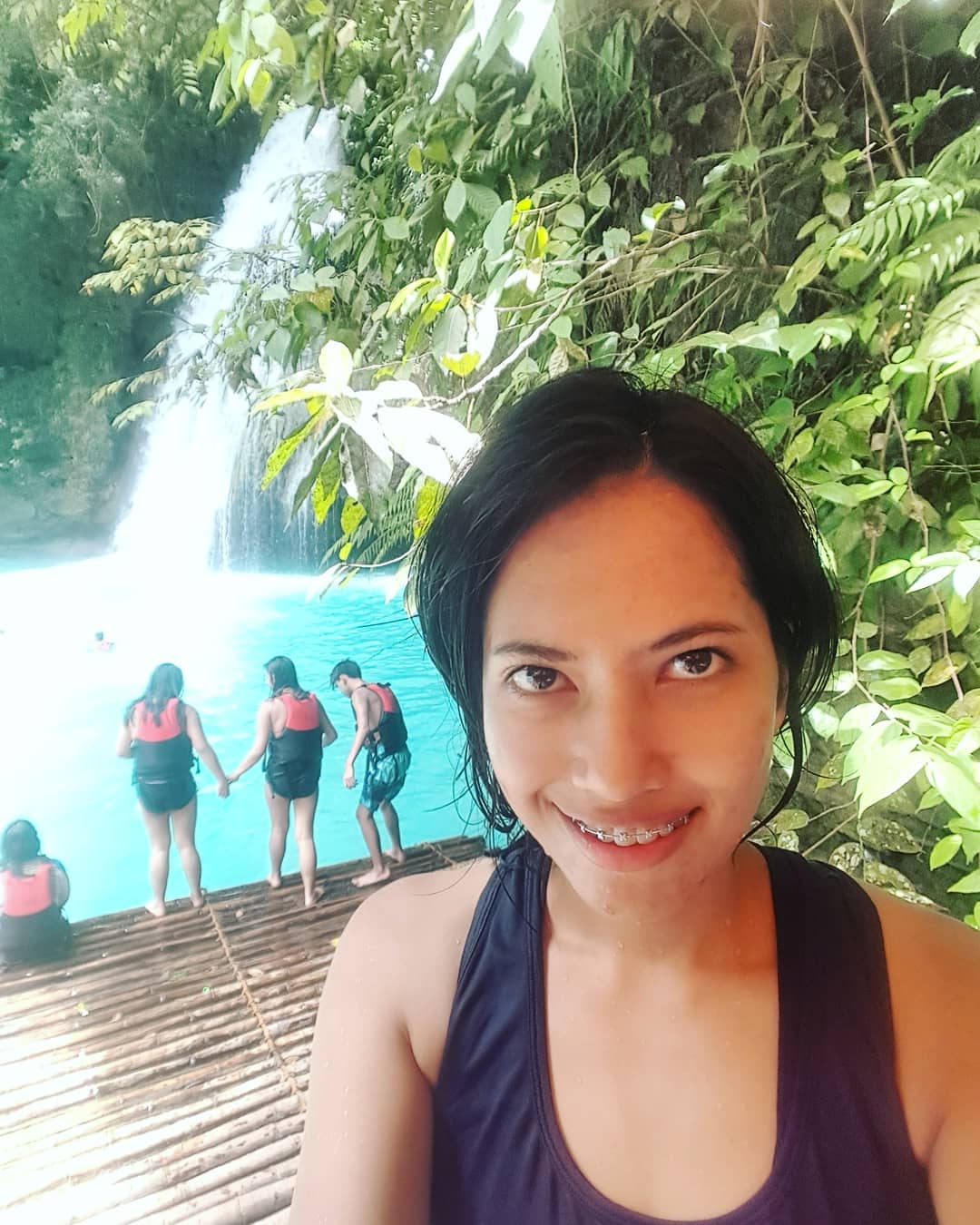
After a couple of hours trekking through the canyon, though, reaching Kawasan Falls felt like the perfect finale.
It was nice to simply relax in the water and enjoy the scenery without having to worry about the next jump.
Everyone was required to wear a life jacket, especially near the waterfall.
There was also a bamboo raft tied near one corner where visitors could usually pay to get a “waterfall massage” by lying face down while the water poured over their backs.
Unfortunately, the raft service wasn’t available on the day I visited, so I had to settle for swimming directly under the waterfall.

Well, “swimming” might be a generous word. I was just bobbing up and down, trying not to drown while the water pounded on my head from above.
I managed to enjoy about two seconds of head massage before I called it quits, with my hair plastered all over my face.
Our guide then started calling us back, and it was officially time to end the adventure.

What to bring for Kawasan Falls canyoneering
Since you’ll be swimming, jumping, and climbing through the canyon, pack light and only bring what you really need.
A dry bag is the most important thing to bring. Your guide might have a waterproof bag for the group, but having your own makes it easier to keep your phone, cash, and other small valuables with you.
Just remember that “waterproof” doesn’t mean “indestructible.” Avoid bringing anything you can’t afford to lose.
🎒 Action camera or GoPro
If you want to capture the adventure, bring an action camera instead of your phone. A bobber (floating hand grip) is highly recommended so you don’t accidentally lose it during the jumps.
I used a cheap action cam. And since I didn’t have a bobber, my guide made a makeshift one using an empty bottle.
🎒 Water shoes or shoes with good grip
Do not wear flip-flops.
The rocks can be slippery, so wear shoes that can get wet and have good traction. Water shoes, trekking sandals with straps, or an old pair of sneakers work well.
🎒 Quick-dry clothes and swimwear
Wear something comfortable that dries quickly. A swimsuit with a rash guard or quick-drying shirt is ideal. Avoid cotton as it becomes heavy once wet.
🎒 Change of clothes and towel
You will finish the tour completely soaked, so bring a lightweight microfiber towel and a dry set of clothes to change into afterward.
🎒 Extra battery or power bank
The tour can take several hours, and recording videos will drain your battery quickly. Bring a spare battery or make sure your camera is fully charged.
🎒 Cash
Bring some small cash for snacks, drinks, or other purchases along the route. Keep it safely inside your dry bag.
Leave these behind
Avoid bringing:
- Expensive cameras
- Jewelry
- Large bags
- Unnecessary electronics
- Anything that cannot get wet
FAQs
How physically fit do I need to be?

You don’t need to be extremely athletic, but you should have a reasonable level of fitness.
The tour involves several hours of walking, swimming, climbing over rocks, and getting in and out of the water repeatedly.
If you have mobility issues, injuries, or medical conditions that could make this difficult, it’s best to check with your doctor or tour operator beforehand.
Can I do Kawasan Falls canyoneering if I can’t swim?
Yes, but you should be comfortable being in the water.
You don’t need to be an expert swimmer, and you don’t have to swim across long distances by yourself. Everyone is required to wear a life jacket, and your guide will be there to assist you throughout the route.
However, this is still a water-based activity. You will be floating, wading, and moving through pools of different depths, so being completely terrified of water may make the experience more stressful than enjoyable.
If you can’t swim, let your guide know before starting the tour. They can keep a closer eye on you and help you navigate the more challenging sections.
Can I do Kawasan Falls canyoneering if I’m afraid of heights?
Yes.
And I say this as someone who is very much afraid of the falling sensation.
The good news is that you don’t have to do every single cliff jump. While the jumps are what make Kawasan canyoneering famous, many of them are optional.
If you don’t feel comfortable jumping, you can usually take an alternative route or let your guide know.
I personally skipped a couple of jumps, including the highest one, and still had an amazing time.
The canyon itself is the real attraction: the blue water, rock walls, natural slides, and swimming through the gorge are just as memorable as the jumps.
Is Kawasan Falls canyoneering safe?
Generally, yes, as long as you follow your guide’s instructions.
The route involves swimming, climbing over slippery rocks, and jumping into pools, so there are always some risks involved.
This is why going with a licensed guide and wearing proper safety equipment are important.
Your guide will tell you where to jump, where to step, and which areas to avoid. Don’t try to rush ahead or attempt jumps that you aren’t comfortable with just because other people are doing them.
Is Kawasan Falls canyoneering suitable for children?
It depends on the child’s age, confidence in water, and the tour operator’s requirements.
Some operators have minimum age limits. Always check with your chosen operator before booking.
Additional tips for Kawasan Falls canyoneering

- Book with a reputable operator. Don’t choose purely based on price. Make sure they provide proper safety equipment and licensed guides. Online platforms such as Viator, GetYourGuide and Klook allow you to compare prices and read reviews before you book.
- Start early if you can. The canyon gets crowded, especially on weekends and holidays. An early start means shorter waiting times and a more enjoyable experience.
- Avoid peak periods. Public holidays and weekends can get very busy, with long queues at the jumping spots.
- Stay in Moalboal if possible. It’s the most convenient base for Kawasan Falls and also gives you easy access to other attractions like the sardine run.
- Check your travel insurance coverage. Not all policies cover adventure activities like canyoneering, cliff jumping, or canyoning, so check the fine print before buying.
Final thoughts

Canyoneering at Kawasan Falls was definitely one of the highlights of my trip to Cebu.
While I didn’t complete every single jump, I still had an incredible time swimming through crystal-clear blue water, navigating the canyon, and ending the adventure at the stunning Kawasan Falls.
Of course, part of me still wishes I had been brave enough to do all the jumps.
When I got home and watched the videos, I couldn’t help but feel a little jealous. My camera had captured more footage of John than me, as he confidently leapt into the water while I was busy negotiating with myself.
But adventure isn’t always about conquering every fear. Sometimes, it’s simply about showing up and pushing yourself a little further than you normally would.
So, is Kawasan Falls canyoneering worth it?
Absolutely.
Whether you’re an adrenaline junkie or a nervous traveler like me, this is one Cebu experience I would highly recommend adding to your itinerary.
You may also like:

thanks so much for sharing the amazing pictures & videos of your canyoneering adventure 😀 Really wish I can enjoy the same after the pandemic is more stable & able to travel out of Malaysia. cheers, siennylovesdrawing
I wish the same. Would really love to visit again as there were a few more places in Cebu that I didn’t get to see.
nice tips from ummi! so packed with useful information that everyone can refer on
Glad you found it useful! 🙂
Ini dah kira aktiviti lasak ni. Tak tahu lah Marsha berani buat ke x? Tapi Cebu memang dalam wishlist travel. Bestnya!!
Memang agak lasak juga la, saya pun skip a few jumps. Kalau taknak buat yang ni, pegi Kawasan falls je pun ok. 🙂
The water is so beautiful. Its remind me to my trip to Erawan Waterfall in Thai. I wish i have a gut to do the canyoneering like u 🙂
I didn’t think I could do it either, but it was not too bad actually. Oh, and I haven’t been to Erawan. Thank you for mentioning it, I will check it out.
Can I skip all the jumping from cliffs and go straight to the beautiful aquamarine water there? I am not scare of heights but I don’t like the idea of jumping off to uncertainty hahaha
Hahaha yes, it’s actually possible to go to Kawasan Falls only. That’s why there are always big crowds there.
Wow this is a really nice amd informative article. Very useful for those who plan to go there (definetly after Covid 19).
Thank you. And hope you’ll find it useful someday if you do plan to visit. 🙂
Perghh… Seronoknya kita baca! Terasa keseronokannya. Gambar menarik siap ada video. Tentu nya awak nak ulangi lagi moment ini kannn?
Ya..kalau boleh memang nak ulang lagi, sebab rasa menyesal pulak tak jump semua cliff tu.
wah seronoknya aktiviti macam ni. sebenarnya first time tau perkataan “canyoneering” ni. tak sabar nak habis pkpb ni, bolehlah cari aktiviti2 lasak mcm ni 🙂
Haa.. sekarang dah tau pasal canyoneering, kena la pergi cuba! 😉
Seronoknya baca dan lihat gambar perkongsian dari awak. Sekali sekala dapat buat aktiviti macam ni memang satu terapi tau.
Glad you enjoyed the article, Eiza. Memang rasa macam satu terapi, sambil mencabar diri untuk lawan rasa takut. 🙂
Cantiknya view kat sini.. Air bewarna biru tu buat TB terasa nak pergi kesini juga.. One day..
Haah, macam so surreal warna air kat sini. 😀
Never try this activity before! Wow, there are so many activities to be done here in Philippines tho! Need to start creating my itinerary based on your suggestion 🙂 Interesting!
Please do! There are many things to do on the island. I hope you get to visit soon.
Amazing gilaa laaa Ummi oii, jeles plak Sis nengoknyaaa…
Btw, jika tak bawa semua gadjet, so ada pihak sana yaa yang amikkan gambar? Or hanya kena use go-pro.. sorry if terlepas baca atas tu..
Tapi serius arr best !! Arghhhhh
Agaknya depends on company kot, atau depends on the guide. Guide saya aritu tak provide apa2 gadget pun. Saya yg bwk sendiri, tapi dia yg tolong ambikkan gambar la. Saya guna sports cam murah je, bukan GoPro.
belum pernah sampai lagi kat sini. nampak gaya aktiviti yang perlu dicuba ni. hope covid19 pergi jauh2 dari bumi ni. rindu nak travel ni.
Semoga berpeluang nanti. Buat masa sekarang, sama2 la kita lakukan apa yg patut utk putuskan rantaian Covid-19.
Cantiknya air dia.. Blue light.. Pergh tengok macam best.. Seram pun ada.. Hehehe.. Syokla you dapat buat aktiviti ni semua.. Best2..
Ya, cantik gila air kat sini. Tapi time nak terjun tu mmg seram jugak. 😆
cantik sangat tempat dia! Rasanya pernah nampak sebelum ni. First time tahu canyoneering tu apa. Tapi kalau pergi time hujan takde pacat lintah ke? Hehehe
Hahaha tak perasan la pulak ada pacat ke tak. Lagipun kitorang tak stop lama pun kat satu2 tempat tu. Sentiasa bergerak, so pacat pun tak sempat nak gigit kot.
Wow nice sharing! Hope to go back to travel again with my family again real soon!🙂
Me too. Wish I could go back to solo traveling soon.
Wah cantiknya air. Biru kehijauan yg cukup.memberi ketenangan. Best Kalau dapat datang ke sini
Kan? Bila dah nampak depan mata baru percaya air tu real, bukan camera filter.
Nicela you suka buat aktiviti lasak dan fun macamni. Air tu pun nampak cantik dan nampak macam biru dia lain macam. Sure sejuk dan best je mandi ni
Ya, sejuk. Kalau pergi waktu hari panas, memang best. Btw, warna biru air tu memang ori tau, no filter 😄. Saya pun mcm tak percaya masa first time tengok.
How I wish I could take part in such extreme activities. Being close to mother nature and testing your limits. But then again the rewards will be amazing. Just look at the breathtaking views and the beautiful blue water.
Yes, Canyoneering in Cebu is really awesome. The reward at the end, and also the whole journey are very rewarding. 🙂
Pingback: Waterfall Abseiling in Sungai Pisang, Malaysia – Ummi Goes Where?
Pingback: Can You Scuba Dive If You Can’t Swim? – Ummi Goes Where?
Pingback: A Beginner’s Guide to Learning to Surf in Bali – Ummi Goes Where?
Pingback: Climbing Osmeña Peak in Cebu, Philippines – A Beginner’s Guide – Ummi Goes Where?
Pingback: White-Water Rafting in Slim River, Malaysia – Ummi Goes Where?
Pingback: Swimming with Whale Sharks in Oslob – What to Expect – Ummi Goes Where?
Pingback: Datanla Alpine Coaster, Dalat – A Review & Guide – Ummi Goes Where?